SAIC Professional Practices
Work In Progress

Before I left New Orleans to start this program. I had unrolled an old painting that I didn’t like as a means for instigating movement. There were no looming creative deadlines, and lots of life demands outside the studio. So this was a way to get moving. To try and move forward. To innovate beyond what I had been doing previously. Because I wasn’t attached to this painting, I felt free to cut it up into 4 pieces. I wasn’t sure what to do with them, but they were the only thing I had in process when it was time to leave for Chicago. So I shipped them to myself and hung them up on my studio wall.

Before I had a single class, I had a studio visit with Pamela Sneed. She and I sat and looked at these painting pieces and talked and wrote a poem together. Until this point, I had seen them as separate pieces. She saw them as one, and she was right. They still belong together. She also saw them as a woman’s body. And she was also right about that. I had seen one piece as related to female reproductive anatomy, but I hadn’t seen it as one body altogether.
Since then, I’ve gone through iterations of how I think I’d like to move forward with this piece. I’ve thought about mounting them on wood. I’ve thought about quilting them. Lately, I want to sew and stuff them in sections and potentially surround them with lace. I’m leaning toward utilizing a material language that may reference a young girl coming of age. Starting to understand her body, her sexuality. Understanding herself as desiring and as desirable. Questioning what it looks like to manage that.

This project will take some time. I’m learning to sew for the first time and exploring how to sew different types of fabrics and what the process is for constructing the end product I’m envisioning. The next two weeks will be full of mistakes and surprises, pleasant and disappointing. I’m already seeing ways I’ll need to improvise. My goals are to keep working this next week. Keep moving forward. Sewing one part of the piece. Experimenting. Uncovering the improvisations needed and making decisions to shift directions when needed. Then moving onto the next. And making a plan for how to move forward when I get back to New Orleans.
Interview Between Catherine Walker and Kaleena Miller
Catherine Walker Interviews Kaleena Miller:
CW: How did you find yourself in tap dance?
KM: My family moved to St. Cloud MN in the early 80s, and my mom found some part-time employment at a local dance studio, assisting the director/teacher. I would hang out in a stroller as dance classes went on, and eventually Karla (the director/teacher) said something to the degree of “Let’s get her in some shoes!” I was 2.5 years old. I studied Ballet, Jazz and Modern as well, but Tap Dance always was the most satisfying form for me, and it always abstractly felt like home.
CW: In this moment of broadening your artistic expression, what are you excited about? Material? Subject matter?
KM: I am excited to solidify some new directions…my head is everywhere right now. Fabric! Wood! Graphic scores! Video! Audio! Costume! Don’t get me wrong - considering the endless options is exciting, but it’s a little exhausting.
With / within all of these possibilities, I’m thinking about the expansiveness of sound and movement, and how it can materialize in a physical, non-human form. I’m thinking about the implied sound that material and shape have; how looking at an object and considering it is a form of improvisation - it doesn’t necessarily formally become a song or dance, per se, but I feel like observation and thought swim around like bits of abstract movement and dance.
At the end of the day, I’m invested in Tap Dance as a medium to explore, and I’m hoping that these more material pursuits can complement or expand the practice that I’m really devoted to. We’ll see where I’m at in 3 year’s time.
CW: Will you talk a little more about the relationship between movement and sound?
KM: It’s my understanding that all sound comes from movement: the noisy air conditioner is spinning moving parts, humans vocalizing is body parts working together to sound, a nail getting hammered is loud and comes from a big movement and two hard objects meeting.
I think it’s important and interesting to care about sound, and that means considering the action behind it.
I just read an article about the Glasgow Improvisers Orchestra - it said their work requires “a type of social virtuosity: virtuosic listening and virtuosic decision making and problem solving”, and I think this resonates because of the care and thought that goes behind the movements that will ultimately sound. And also the care and thought that the audience needs to hold as well - removing expectations of what music needs to sound like.
CW: Please say more about American Apparel disco pants and why they deserve a funeral!
KM: Ha! They were SUCH A THING in dance performance as (I think) social media was just starting to pop. They were stretchy, high-waisted, and form-fitting - they stayed in place, you could move in ‘em, and they looked great on pretty much everyone. They became ubiquitous, and, for me, sort of attached to this idea of promotion for promotion-sake, just as an incredibly accessible platform for self-promotion (instagram) was starting to sky rocket. So it’s a slice of dance culture that I’m just ready to be done with: ego, self-promotion, narcissism. Plus, Dov Charney (American Apparel CEO) is a creep.
CW: In your reflections, you talk both about the acts of breaking and building. Breaking down yourself and your work, and building spaces for listening and community. I think this is an interesting dichotomy. Do you see them as connected and why or why not?
KM: I think 2019-2020 was sort of a breaking point for me - I was really burnt out and had lost scope of why I was doing what I was doing. And then, pandemic. And I moved to a new city. And there was re-building all around. I knew the structure of my previous version of life was not right, and, honestly, I’m still working it out. So I’m distilling…figuring out the elements that make my existence tick and feel meaningful. Breaking down my life to re-build it again.
’m doing the same in my medium of tap dance. I’m in a mode of thinking about the basic elements of tap dance steps and phrases - toe, heel, ball, slide, flam, etc - and using a run on sentence/“daily making practice” alongside chance operations to create new and unexpected patterns. I’m working to find an “elsewhere” / find new pathways / go against expectations of the form.
I ran 2 organizations in Minnesota - I ran them for “the community” - but I don’t know that I / we did it right. Was it to prove something for myself? Or was it TRULY for other people. Probably a little bit of both.
Both orgs are being re-imagined at the moment - trying to set up structures and carve out space that feels akin to our values, and not just based on what similar orgs have done before us. Focusing on setting up spaces, opportunities and programs that REALLY feel like the listening, sounding, and caring community that we’ve always dreamed of.
So, yeah! They’re connected for me - I can’t get to the re-build of work or the ideal community space without completely breaking down what IS or WAS.
Kaleena Miller Interviews Catherine Walker
KM: How did you find yourself in painting?
CW: My path into painting was slow and kind of indirect. In most American schools, kids start understanding themselves in middle school as either good or bad at art. I was no different. I remember my middle school art teacher looking at a drawing I made, and her comments were more like a diagnosis of whether I had what it takes to ever be an artist, rather than advising how to see what I was drawing more clearly. From that point until my senior year in high school, I saw the identity of Artist as binary. One in which I didn't belong and one over which I had no agency. I finally took a 9 week art class at the very end of senior year. I was actually decent enough and I loved it. From there, I took a few classes in college, a few community classes when I got out of college, and tried to paint when I could. I was still too afraid to really commit to it, for fear of failure, and the need to support myself financially. I had demanding jobs that were creative, but that also absorbed all my energy, leaving very little for painting. It wasn't until my later 30s and after my youngest baby turned one, that I finally took the time to commit to painting more consistently.
KM: In this moment of broadening your artistic expression, what are you excited about? Material? Subject matter?
CW: My subject matter needs to get less broad! I've got these massive topics that have always interested me, but I'm hoping to distill some of that through this MFA experience. I'm very excited about experimenting with new materials. I've been craving to work with fabric for years now, and I'm finally getting the time and resources to wade into the possibilities that media offers. I've also always loved relief and screen printmaking, but It's been a long time since I've done it. I'm excited to have the chance to play around with that too.
KM: You write that your research topics are huge right now - I agree! "Patriarchy in the history of the church, white women in racial and social structures in the American South, Feminism, Fashion, Control" Can you talk a little bit about how you landed on these topics of investigation - what led you here?
CW: These topics are deeply layered and personal. Both of my parents grew up in a tiny town in north Mississippi and my dad studied to be a pastor in Jackson, MS. The cultural traumas related to the evangelical christian church and gender in the south always affected my relationship with my mom. It wasn't until my dad left my mom much later, that I started being able to unpack how the particular flavor of patriarchy in the southern american church had wreaked psychological havoc on my family and on me personally. So this research feels important for me to unwind the strands of my own experience.
KM: Branching from the conversation on your current research topics, can you talk about what your work has researched/thought about historically?
CW: There has always been an element of the feminine and nostalgia in my work. When I went to NYU to study Art Education, I started looking more specifically at mother/daughter relationships. Some tough dynamics were surfacing between my mom and me at the time and I was working through those. I was in my late 20s then, and hadn't found my partner or had my children yet. So in some ways it was a very one-sided study. But even then, I remember coming to the conclusion that mothers were under an enormous amount of pressure to create the perfect home, children, family. And that this pressure produced a lot of the rage and resentment I saw in my own mother. Now that I am a mother, and have a lot more context for my mother's life experience, I have a similar, but much more whole understanding of my mom and for what motherhood in patriarchal culture means.
KM: Is there anything that you can anticipate these 6 weeks having an effect / carrying on back into your life back in New Orleans?
CW: Six weeks is too short for anything to feel resolved at the end. But I feel like I've been walking around for years with unopened cans of ideas and that these six weeks have been my can opener. So yes, hopefully I'll take everything I've started, related to research and materials, back with me to keep exploring.
A Day In the ...

I’ve been thinking about the differences and similarities in my workflow here in Chicago vs. at home in New Orleans. There is not a linear rhythm of work in either place. In fact, the rhythms here in Chicago feel quite familiar. There are almost no full 8 hour days IN the studio. Rather my days seem to be broken into chunks or blocks. Here, the blocks of time and the activities they hold are all feeding my work, indirectly if not directly. At home, because of the demands of family, home, community, etc. transitioning from one block to the next feels more disruptive. One block may feed my work and the next may be neutral toward it or even destabilize it. In some ways, a full 8 hour day seems like it would feel luxurious. A mythological flurry of focus and productivity. But I’m also aware that the blocks themselves may be useful in the efficiency of attention they demand.
To explain in more detail, I’ll list a series of some time blocks spread over the course of a few days this week:
Studio time (painting): 3 hours
Art History: 4 hours
Goodwill for art materials: 2 hours
Studio time (material arranging): 2 hours
Colloquium: 3 hours
Art History reading: 2 hours
Researching the history of Corsets: 2 hours
Art History: 4 hours
Flaxman Library: 2 hours
Fabric Store: 3 hours
Studio time (admin): 1 hour
Blick: 1 hour
Studio time (painting): 2 hours
Block Museum/Exhibition: 3 hours

So I’m going to use “Studio” as more of a concept here instead of a concrete place or space. Part of the reason my rhythm is still broken into this kind of block pattern is because of where I am trying to go with it. In New Orleans, my actual work was more streamline. Most of the paintings I was making were aesthetically, materially and procedurally very similar. Here, I am broadening both my research and my material processes in order to ultimately deepen and specify the meaning of the work. My research topics are huge right now. The goal is to pull all the strands apart so that I can pick specific ones to grab onto. Patriarchy in the history of the church, white women in racial and social structures in the American South, Feminism, Fashion, Control.

I’m experimenting with many more materials. I’m trying to play as much as possible and let them the materials talk to me. Follow where they lead. Rather than just acrylic paint on a rectangle canvas, I’m cutting canvas out and rearranging it, potentially quilting, sewing, screenprinting, monoprinting, and more.
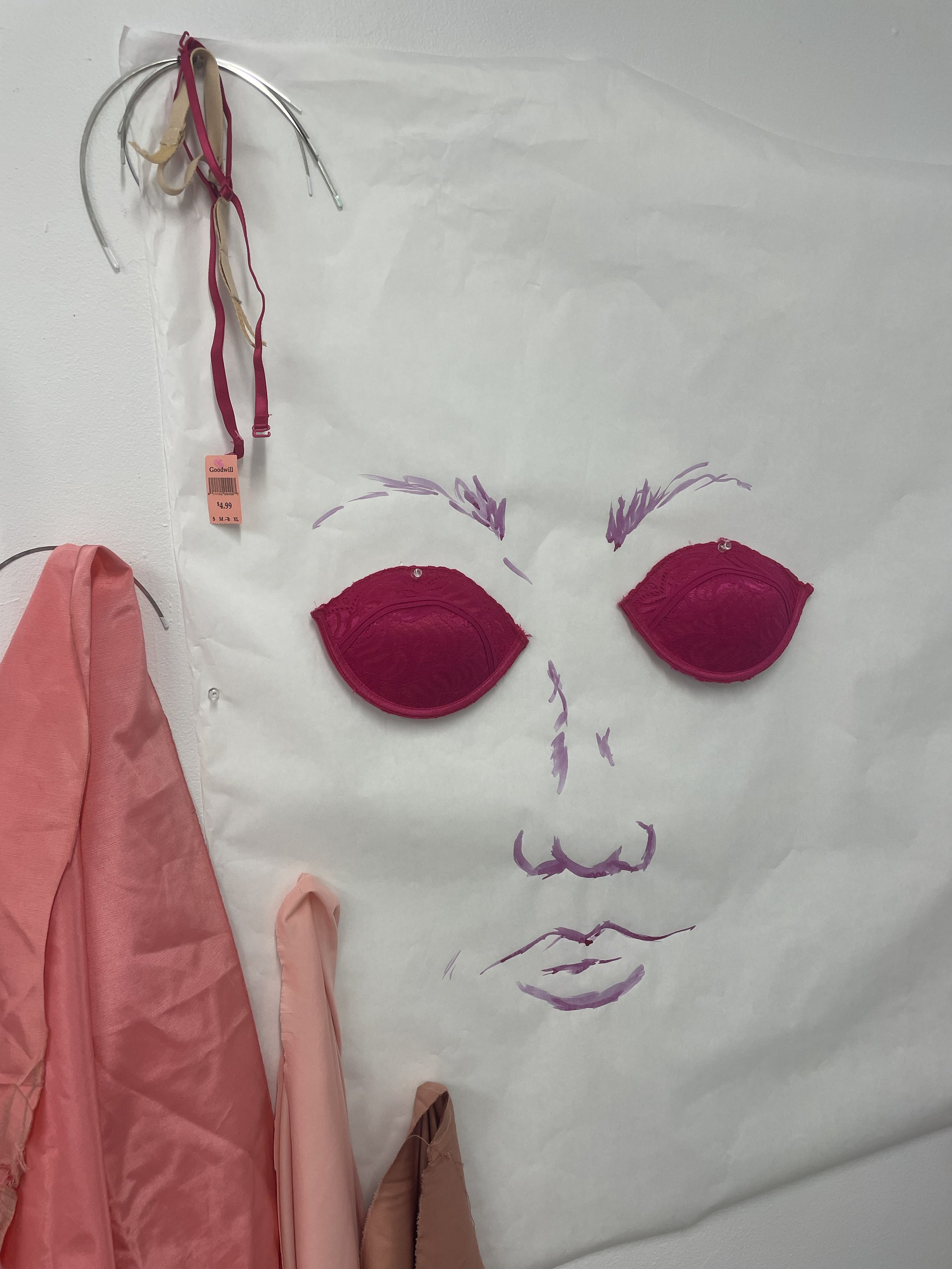


"Professional" Practice

When one hears the word practice, they may initially think of the concept in terms of sports. Going to baseball or soccer practice. Swim practice. Or perhaps in terms of a musical instrument. When I was young, my daily routine started with piano practice as soon as I woke up. Playing scales over and over. Playing and replaying certain pieces I was learning. As such, the word practice connotes an idea of conscious intentionality. A clear plan in place, set by an instructor, coach, or oneself. The plan likely involves performing a task over and over again to a determined end or goal. And that goal is typically the improvement of particular skills that may improve one's overall performance in the sport or instrument.
When I think of my art practice, though, very little of this applies. I’ve come to know my practice as fundamentally intuitive and improvisational. A conversation of actions and reactions. Most often, no action could be predicted or planned except maybe the very first one. Each following reaction is a response to the one before.
But what if practice is intentionally subconscious rather than conscious? Can practice happen from the hours of 2am to 4am when my mind wakes racing with ideas? Can practice be completely unplanned? Completely out of my conscious control? In my work, I’m convinced this openness can be more productive than a specific regiment of disciplined drills.
But there is still plenty of intentionality in my practice of making art, the act of practice being the regularity with which I show up to my studio with intentional mindsets. A commitment to growth and experimentation. A resistance to complacency manifesting itself in creating the same type of work over and over again because it “sells well” or is palatable. A commitment to protecting open space in my mind. A landing pad for ideas when they’re ready to arrive. A permissive stance, allowing my mind and my hand to wander where and when they want. A determined resistance to control. To over planning.
I think it’s interesting to think of “professional” in the context of art making. The dictionary definition qualifies an activity or occupation as professional only if it produces an income one can live on. A main source of income. I do make money through my artwork, but currently not enough to be my main source of income. If I wanted to predictably make plenty of money, I would likely choose a different “profession”. This idea brings up interesting questions about choice. Whether one chooses to be an artist or whether artists are chosen by the work. And there may be little control over the work’s monetary value. Where does that value come from and who decides whether a work is valuable or not? Especially in this moment of history that entrenches creative work in social media, people who choose to be an artist may make more money than those I would identify as professional artists. And that is often true because these makers are “mass producing” objects that are “pretty” and palatable for a majority of consumers.
If I must use the word professional to describe artists or an artistic practice, then I might say professional artists are those who are chosen BY the profession rather than choosing the profession. Marylin Minter said, “Only be an artist if you have no choice!” Professional artists have no choice. They’re driven to create, not by those who would consume it, not by the money they will make, but by the work that is embedded inside them and must be released.